

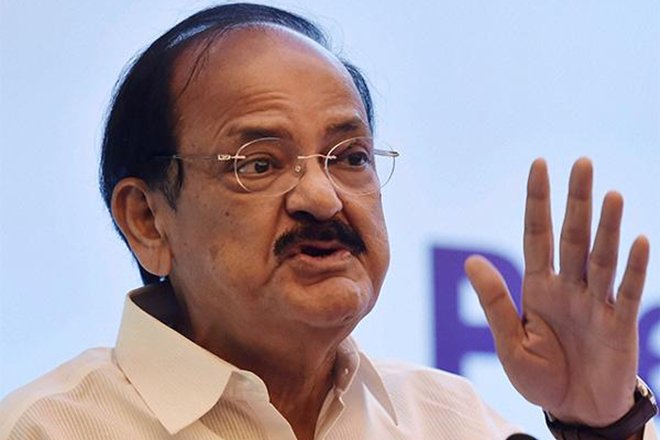
The Vice President of India and the Speaker of Rajya Sabha rejected the impeachment motion against Chief Justice of India today as there is no valid grounds to admit the same. The Motion has been signed by 64 MPs levelling five charges against the Chief Justice of India and presented the same to the Vice President of India for discussion before both the house of Parliament. On receipt of the same, a detailed order of rejection has been passed.
The Rejection is mainly on the ground that as per Article 124(4) of Constitution of India, there must be a proved misbehaviour or incapacity, which is very much absence even on the face of the motion itself. Mr. Venkaiah Naidu, has relied upon the provisions of Article 124(4) of the Constitution of India and relied upon the Judgments of Apex Court. The learned Vice President of India relied upon the decision in M. Krishna Swami vs Union of India (AIR 1993 SC 1407) wherein it is held that
“Before admitting the motion, it may be expected and may be prudent that the Speaker may consult persons like the Chief Justice of India, the fountain head of judiciary, and the Attorney General of India, the Principal Advisor of the Govt., whose duty should be to give advice upon legal matters or to perform such duties of legal character. It is also equally salutary that before admitting the motion to remove the judge, there shall exist factual foundation. The grounds mentioned in the motion, the material or evidence placed in support thereof and the advice tendered, if consulted, would form “the record”. He would consider that record and filter the process before deciding to initiate proceedings or refusal thereof. He need not weigh the pros and cons to find prima facie case. He acts neither as a quasi-judicial nor an administrative authority but purely as a constitutional functionary and with high sense of responsibility and on due consideration of ‘the record and arrives at a decision to admit or refuse to admit the motion to remove the Judge. The Speaker, therefore, would act with utmost care, caution, circumspection and responsibility and wholly guided by considerations of larger interest of the public administration of justice. He would equally keep in his gaze and the mind the seriousness of the imputations, nature and quality of the record before him and its indelible chilling effect on the public administration of justice and independence of the judiciary in the estimate of the general public.”
By the guidance of the above decision, the Vice President of India looked into the matter. Since the charges levelled against the Chief Justice of India, the Vice President has not made any consultation with the CJI.
It is further observed in the order that as per section 3(1)(b) of Judges (Inquiry) Act 1968 a Motion for removal of a Judge of the Supreme Court or a High Court should be signed by not less than 50 members of the Council and the Present petition meets the requirement of the aforesaid section.
Mr.Venkaiah Naidu points out that even on a mere reading of the petition it did not disclose any concreate evidence against the Chief Justice of India. The Petition itself points out only suspicious involvement of Chief Justice of India, which will not meet the criteria as specified in Article 124(4) of the Constitution. Mere surmises and conjectures will lead to a motion for removal of a person from the highest authority of the constitutional post.
The order says that “The Hon’ble Members of Parliament who have presented the petition are unsure of their own case. Page 1 of the petition uses phrases such as “the facts and circumstances relating to the Prasad Education Trust case show prima facie_evidence suggesting that the Chief Justice of India ‘may have been’ involved in a conspiracy of paying illegal gratification….” The motion further states with regard to “the Chief Justice of India that “he too was likely’ to fall within the scope of investigation”. It further states that “the Chief Justice of India appears to have anti-dated an administrative order”. I am mentioning this fact because the phrases used by the Hon’ble Members of Parliament themselves indicate a mere suspicion, a conjecture or an assumption. The same certainly does not constitute proof “beyond reasonable doubt”, which is required to make out a case of “proved misbehaviour” under Article 124 (4). Conversations between third parties with dubious credentials, which have been extensively relied upon, cannot themselves constitute any material evidence against the holder of the office of the Chief Justice of India”.
The Speaker further factually responded to the charges of arbitrary allocation of cases to the bench as per whims and facies by relying upon the decision in Kamini Jaiswal vs Union Of India, wherein it is held that the Chief Justice is the Master of Roaster.
The Vice President also expressed his displeasure for the violation of the guidelines prescribed under the Handbook of Rajyasabha, which prohibits publicity of any Notice submitted by a member till it has been admitted by the Chairman and circulated to the members. But in the case on hand, even before admission, the petitioners published the same in press conference.
It is also mentioned that the Speaker has consulted with various experts before arriving at a decision. The Vice President has also assigned a reason for earlier disposal of the above petition in view of the discussion of the subject matter in public domain.
Read the Order here
rejection of impeachment
More Stories
The Court is not bound to follow statute or rules of evidence while deciding the custody of a Child and the only consideration should be the welfare and well-being of the child- Supreme Court Reiterated
When the Agreement specifies particular type/mode of constitution of Arbitral Tribunal, the same should be followed in strict sense- Supreme Court clarified.
The Hospital is vicariously liable for the acts of negligence committed by the Doctors engaged or empanelled to provide medical care- Supreme Court Ruled